
Prof. Stefan Vogt-Geisse and Dr. Namrata Rani Participate in Pacifichem 2025 with Talks on Astrochemistry
16 - January - 2026
Dr. Stefan Vogt-Geisse and Dr. Namrata Rani from the QCMM group at the Universidad de Concepción participated in Pacifichem 2025, one of the world’s largest scientific gatherings, held in Honolulu, Hawaii, from December 15 to 21, 2025. The conference brought together over 10,000 scientists from around the Pacific Basin, with more than 300 symposia and 17,000 presentations across a wide range of chemical sciences.
Both researchers took part in the symposium titled “Astrochemistry and Astrobiology Beyond the Second Period”, contributing to cutting-edge discussions at the intersection of astrochemistry and molecular astrophysics.
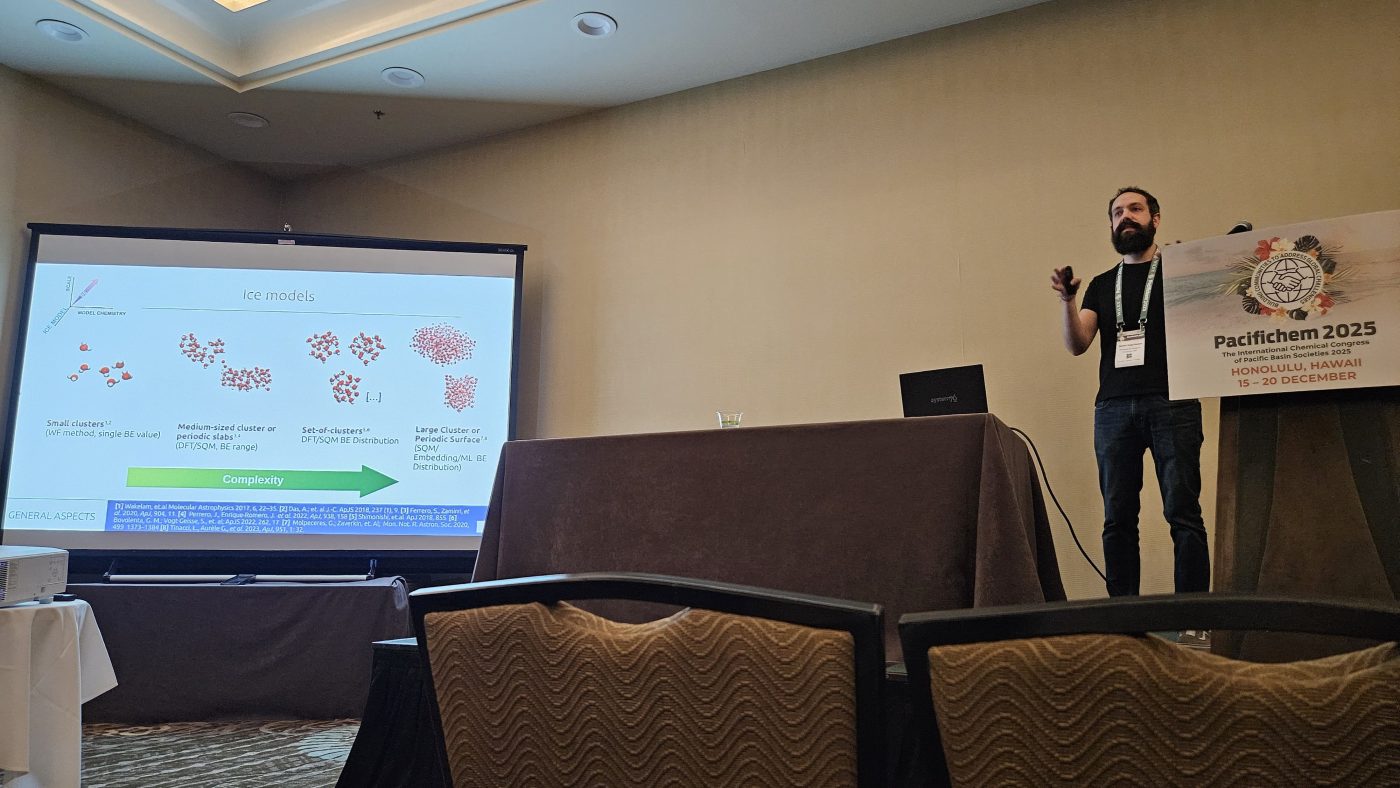
Dr. Stefan Vogt-Geisse delivered an invited talk titled “Binding Energies of Interstellar Species on Ice-Grain Mantels: Beyond the Second Period”, where he presented recent advances in the systematic evaluation of binding energies for interstellar molecules adsorbed on amorphous solid water (ASW) surfaces.
His work showcased how combining high-level quantum chemical methods with realistic ice models—such as those implemented in the BEEP platform, can provide a consistent and accurate database of binding energies for molecules beyond the second period, contributing to improved astrochemical modeling of dust-grain chemistry in interstellar environments.
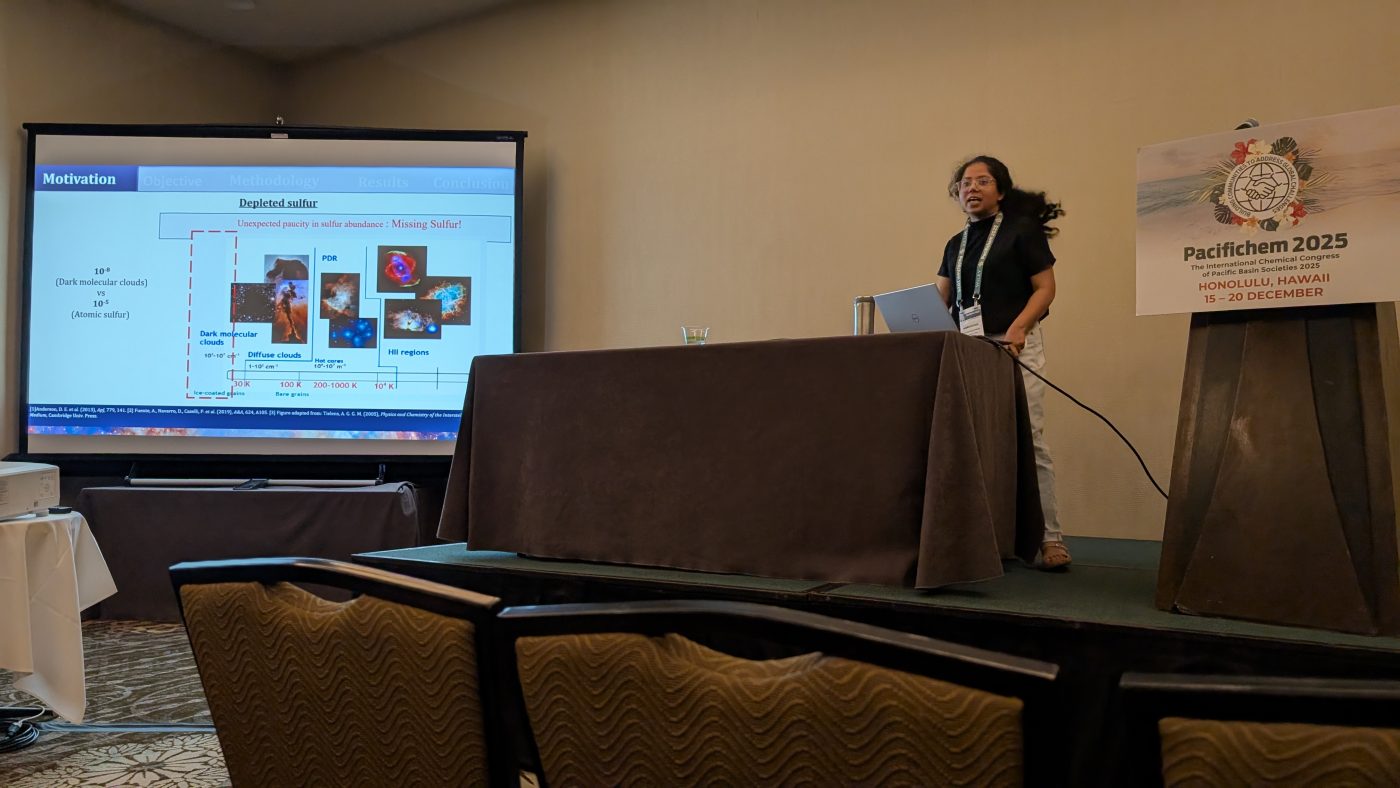
Dr. Namrata Rani gave a contributed talk titled “Sulfur Chemistry in the Interstellar Medium: Formation Pathways of Thioethanal and Competing Channels”, where she explored the mechanistic and energetic details behind the synthesis of sulfur-bearing species in cold interstellar environments.
Her talk emphasized the role of quantum chemical methods in understanding sulfur depletion and proposed alternative reaction channels that could explain the presence of complex sulfur molecules in star-forming regions.
Their participation highlighted the Dr. Vogt-Geisse’s group leadership in astrochemistry research, particularly in the development of theoretical tools and models that link fundamental quantum chemistry to the conditions of the interstellar medium. The talks contributed to new scientific exchanges and international collaborations, reinforcing the role of Universidad de Concepción in the global astrochemical community.